
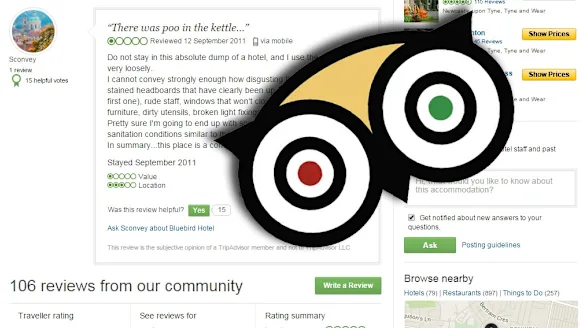
Learn the 7 warning signs of fake TripAdvisor reviews and how to book hotels with confidence using verified, real-stay review platforms.
Nabil Igamane
July 07, 2026 · 143 views
You've narrowed your hotel search down to a property with a 4.8-star rating and glowing reviews. It looks perfect. But is it real?
Fake reviews are one of the biggest hidden risks in travel planning today. Tripadvisor's own 2025 Transparency Report found that around 8% of the 31.1 million reviews submitted to the platform in 2024 were fake — and the company removed 2.7 million fraudulent reviews that year alone. That's a lot of noise standing between you and an honest picture of where you're about to spend your money and your vacation days.
The good news: fake reviews follow patterns. Once you know what to look for, you can spot most of them in under a minute. Here's how.
Why Fake Reviews Are a Growing Problem
Fake reviews on travel platforms generally come from two directions:
- "Review boosting" — business owners, staff, or hired services post glowing five-star reviews to inflate a listing's ranking. This accounted for the majority of fake review submissions on TripAdvisor in 2024, at 54% of total fraud detected.
- Competitor or extortion attacks — rivals, or in some documented cases organized groups, post fake one-star reviews to damage a competitor's reputation, sometimes as leverage to demand payment for their removal.
Generative AI has made both problems worse. Tripadvisor removed more than 200,000 reviews it suspected were AI-written in 2024 alone, and AI-generated text is specifically designed to sound like a genuine, emotionally detailed traveler account — which is exactly why it's getting harder for the human eye (and even for platform algorithms) to catch on sight.
7 Warning Signs of a Fake TripAdvisor Review
1. Overly Generic or Repetitive Language
Real travelers mention specific details: the name of a staff member, the exact room number or view, a specific dish, a specific problem. Fake reviews tend to stay vague — "great service, clean rooms, will come back" — because the writer (human or AI) never actually experienced the property.
2. A Burst of Reviews in a Short Window
Check the review timeline. If a property suddenly gets 20–30 five-star reviews within a few days — especially after a slow period — that's a classic sign of a bought review campaign or a coordinated boosting effort.
3. Reviewer Has Only One Review, Ever
Click on the reviewer's profile. If the account was created recently and has posted exactly one review — for this property only — treat it with suspicion. Genuine travelers tend to have review histories across multiple destinations over time.
4. Extreme Ratings With Thin Detail
A perfect 5-star or a brutal 1-star review that's only two sentences long, with no specifics, is worth a second look. Genuine extreme experiences (amazing or terrible) usually come with a story, not just a verdict.
5. Suspicious Phrasing Patterns Across Multiple Reviews
If you scroll through a property's reviews and start noticing the same odd phrase or sentence structure repeating across "different" reviewers, that's often a sign of a single source — a review farm or an AI tool — writing multiple entries.
6. Mismatched Photos
Some fake reviews include stock photos or images that don't match the property at all — wrong furniture, wrong view, sometimes even a different country's architecture in the background.
7. No Verified Booking or Stay Attached
This is the root issue behind all the signs above. Most review platforms only confirm that a transaction happened — not that the reviewer actually checked in, walked the halls, and experienced the stay. Without that link, anyone (a business owner, a competitor, or a bot) can leave a review.
What TripAdvisor Already Does to Fight This
To be fair, TripAdvisor isn't ignoring the problem. The platform's 2025 report showed that moderators reviewed roughly 4.2 million submissions before or after posting, using a mix of automated filters, human moderation, and community flagging. Businesses caught encouraging incentivized reviews — nearly 9,000 of them in 2024 — received formal warnings.
But detection is still largely reactive: it happens after a review has already influenced a traveler's decision, sometimes for days or weeks. And as AI-generated content keeps improving, pattern-based detection alone will keep getting harder.
The Real Fix: Verification at the Source
Spotting red flags manually helps, but it puts the entire burden of fraud detection on the traveler. The more durable solution is verifying that a review only exists because a real stay happened — before the review is ever published.
That's the gap Verified Guest was built to close.
Instead of trying to detect fake reviews after the fact, Verified Guest anchors every review to a physical check-in:
- Guests receive a unique QR code only at check-in.
- Only guests who scan that code can submit a review for that stay.
- Business owners can't add their own reviews. Competitors can't leave fake ones. Neither can an AI tool sitting in another country — because none of them were physically present.
It's the same logic SSL brought to websites: instead of asking every visitor to become a fraud detective, you build the proof of authenticity into the system itself.
Verified Stay. Verified Review.
A Quick Checklist Before You Book
Next time you're comparing hotels on TripAdvisor, run through this in under a minute:
- Skim the last 10–15 reviews — do they read like they were written by different people, or does the phrasing feel similar?
- Check a few reviewer profiles — do they have a real history, or is this their only review?
- Look at the review timeline — any suspicious clusters?
- Read the middle-rated reviews (3–4 stars), not just the top ones — they're usually the most honest and detailed.
- Where available, prioritize listings that carry a verified-stay badge, like the Verified Guest badge, over unverified review counts alone.
The Bottom Line
Fake reviews aren't going away on their own — if anything, AI is making them more convincing every year. Even with 2.7 million fraudulent reviews removed in a single year, TripAdvisor's own data shows the fight is ongoing, not finished. Until verification becomes the industry standard, the smartest thing a traveler can do is read reviews with a critical eye — and give extra weight to platforms and badges that prove a stay actually happened.
Want to book with more confidence, or protect your own property from fake attacks? Visit Verified Guest to see how QR-verified reviews work.
Note on sourcing: the TripAdvisor statistics above come from TripAdvisor's own 2025 Transparency Report (covering 2024 data), cross-referenced via CNBC and PhocusWire coverage. I'd recommend linking directly to TripAdvisor's report page (tripadvisor.com/TransparencyReport2025) in the published version so readers — and Google — can verify the source themselves.
Tags
Comments (0)
No comments yet
Be the first to share your thoughts!